



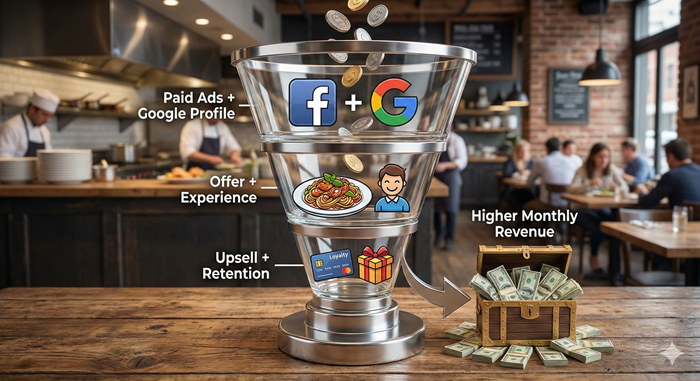
You need a simple system that does 4 things:
- Brings more local people to you
- Converts more of them into orders or reservations
- Increases the average check without annoying guests
- Makes customers come back more often
Below is a practical, step by step playbook you can run in 30 days for a 1 to 2 location restaurant in the US.
Step 1: Pick one sales target for the next 30 days
Do not try to fix everything at once. Pick one “sales problem” and one “sales channel” for the month.
Choose your one sales problem
Pick the one that is hurting you most:
- Low traffic on slow days (Mon to Thu)
- Too many one time guests
- Average check too low
- Not enough online orders
- Too many “views” but not enough calls, reservations, or directions
Choose your one sales channel
Pick one primary channel:
- Google visibility (Google Business Profile)
- Instagram plus Meta ads (local acquisition and retargeting)
- Repeat guest engine (SMS, email, loyalty, bounce back)
Example decisions (copy these)
- Casual dine in: “Fill Tuesday and Wednesday dinner with a weekday offer using Google plus Meta ads.”
- Quick service: “Increase online orders at lunch using Meta ads plus a strong offer.”
- Pizza delivery: “Increase repeat orders with SMS bounce back plus simple upsells.”
Step 2: Fix your “conversion basics” before you promote anything
Most restaurants waste money because they run promotions before the basics are clean.
Your Google Business Profile must be sales ready
Checklist:
- Correct category and hours
- Menu link working
- Reservation or order link working
- Fresh photos (food, dining room, outside sign)
- Reviews answered weekly (yes, weekly)
Google documents how to reply to reviews inside your Business Profile. Make it a weekly habit, it is one of the easiest trust builders.
Practical example: review reply templates
- 5 star: “Thank you, [Name]. Next time, ask for the [best seller] and we will take care of you.”
- 3 star: “Thanks for the feedback, [Name]. If you share what happened, we will fix it. Please message us at [contact].”
- 1 star: “Sorry we missed the mark. We take this seriously. If you can share details, we will make it right.”
- Use Google posts and new profile features when available
Google has been rolling out features that let restaurants highlight time sensitive specials directly on their search profiles, which is useful for daily specials and events.
Action: treat it like a “slow day booster” slot and update it weekly.
Your landing destination must be frictionless
Whatever you promote (reservations, calls, online orders), the path must be short:
- One tap to call
- One tap to directions
- One tap to reserve
- One tap to order
If it takes 4 clicks, your ads and your posts will underperform.
Step 3: Build an offer that fills slow slots without discounting your brand
The fastest way to increase restaurant sales is a strong offer that matches a specific time and guest type.
The 3 rules of a strong restaurant offer
- Specific time: lunch, happy hour, late night, slow weekday
- Clear win: convenience, value, or exclusivity
- Simple redemption: show this post, mention code, order link
Offer ideas that work for most small restaurants
Use these as plug and play:
- Weekday “2 for 1” on appetizers during happy hour (not full menu)
- Prix fixe weeknight dinner for two (limited items, high margin)
- Lunch combo built around your fastest station
- Family meal bundle for takeout
- Catering sampler for local offices (10 to 20 people)
- “Kids eat for $X” on one slow day with guardrails (minimum adult entree)
Example offers (with copy you can reuse)
Weekday fill
- Offer: “Tuesday Date Night: 2 entrees + 1 dessert for $49”
- Copy: “This Tuesday only. Limited tables. Reserve now and say ‘Date Night’.”
Takeout push
- Offer: “Family Pack: feeds 4, ready in 20 minutes”
- Copy: “Busy night? Tap to order. Pickup shelf ready fast.”
Lunch traffic
- Offer: “Lunch Combo in 12 minutes”
- Copy: “In and out quick. Perfect for work breaks.”
Step 4: Run Meta ads with one simple structure (acquisition plus decision)
If you want predictable sales lift, run paid traffic with a clean structure.
Meta explains how campaign objectives align to business goals inside Ads Manager. For most restaurants, you want an objective that optimizes toward sales actions, not just views.
Simple campaign structure for restaurants
Campaign A: Acquisition (new customers)
- Target: people near your restaurant (tight radius)
- Creative: the offer plus social proof
- Destination: call, directions, reservation, or order
Campaign B: Decision (warm audience)
- Target: people who engaged with Instagram, visited site, or watched videos
- Creative: urgency plus best seller
- Destination: same as above
Creative formats that usually win locally
- Short food video (10 to 20 seconds)
- Simple offer graphic (clean text, one CTA)
- “Proof” video: packed dining room, staff plating, quick testimonials
Ad copy templates (steal these)
Template 1: Weekday fill
- Primary text: “Slow day fix: [Offer]. Available [Day] from [Time].”
- Headline: “Reserve in 10 seconds”
- CTA: “Book Now”
Template 2: Takeout speed
- Primary text: “Pickup ready fast. Tap to order in 2 clicks.”
- Headline: “Order pickup”
- CTA: “Order Now”
Template 3: Social proof
- Primary text: “Locals favorite: [Best seller]. Thousands served. Try it tonight.”
- Headline: “Get directions”
- CTA: “Get Directions”
Budget guidance (simple, realistic)
Start with what you can sustain for 30 days. Consistency beats bursts.
- Small test: $20 to $50 per day
- Stronger push: $50 to $150 per day
Adjust weekly based on bookings, calls, or orders, not likes.
Step 5: Increase average check with 5 “no pressure” upsells
This is where many restaurants leave money on the table.
Upsell ideas that feel helpful, not pushy
- Make it a combo: add fries plus drink
- Add a premium side: salad, soup, seasonal veg
- Add a topper: extra protein, avocado, bacon
- Upgrade the drink: mocktail, signature lemonade, local beer
- Dessert with a trigger: “Best with coffee” or “Shareable”
Staff scripts you can print today
- Server: “Most guests pair that with our [side]. Want to add it?”
- Counter: “For $3 more you can make it a combo. Want that?”
- Host: “We have happy hour until 6. Want the bar menu too?”
Menu engineering quick win
Pick 3 items:
- 1 hero item (high margin, high love)
- 1 upsell attachment (side, drink, dessert)
- 1 bundle offer (combo or prix fixe)
Then push those for 30 days everywhere (menu highlight, social, ads, staff script).
Step 6: Build a repeat guest engine (the cheapest sales you will ever get)
If you only focus on new customers, your marketing costs will rise.
The 2 message system that works
Message 1: next day thank you
“Thanks for coming in. Next time, try our [best seller].”
Message 2: bounce back on a slow day
“This Tuesday only: free appetizer with any 2 entrees. Show this text.”
Example SMS copy (ready to send)
- “It was great having you. Reply YES if you want our weekly specials.”
- “Tuesday boost: free [app] with 2 entrees, 4 to 8 pm. Show this text.”
Keep it simple, one message per week is enough for most restaurants.
Proof element: The 30-day restaurant sales checklist (copy and use)
Print this and check it weekly.
Week 1: Foundation
- Google profile cleaned: hours, menu link, photos, call and directions buttons
- 10 reviews replied to
- One offer chosen for one slow day
- Landing path tested on phone in under 15 seconds
Week 2: Launch
- Meta Campaign A live (new customers)
- 3 creatives live (1 video, 1 offer graphic, 1 proof)
- Staff trained on 2 upsell scripts
Week 3: Optimize
- Kill the worst creative, duplicate the best
- Tighten radius and refine audience
- Add one attachment upsell to your hero item
Week 4: Repeat engine
- Collect phone or email at checkout (simple opt in)
- Send one bounce back message
- Add one monthly Google update post and keep it consistent
If you want a done for you version of this system, Gustoma typically pairs Meta paid media management with a practical Instagram setup and, when relevant, Google Business Profile management.
This article is intentionally written as a single intent, people first playbook for restaurant owners, not generic marketing fluff.
Common mistakes that kill restaurant sales growth
- Promoting without a clear offer
- Sending people to a slow website or broken order link
- Posting content that looks nice but does not drive calls, reservations, or orders
- Running only “engagement” ads and hoping sales happen
- Not following up with past guests
- Changing strategy every 7 days before data is clear
FAQ
How fast can I increase restaurant sales?
Many restaurants see movement in 2 to 4 weeks if th Google profile converts, and ads optimize toward actions (calls, directions, orders).
Is Google Business Profile really that important?
Yes. It is often the first thing locals see. Reviews, photos, and accurate info heavily influence decisions, and replying to reviews is a simple trust signal.
What Meta campaign objective should a restaurant use?
Pick an objective aligned with your real goal (sales actions). Meta provides guidance on choosing objectives that match outcomes.
How many posts should I publish per week?
Enough to support your sales goal. If you are running ads, you can often keep organic posting minimal and focus on the offer, proof, and profile.
What is the easiest way to raise average check?
Train staff on 2 upsell scripts, highlight 1 hero item, and attach 1 high margin add on (side, drink, dessert) everywhere for 30 days.
Conclusion
If you want to increase restaurant sales, run a 30 day sprint with one clear offer, clean Google visibility, simple Meta ads (acquisition plus decision), and a repeat guest message system.