



Below you will find 27 ideas you can run fast, with examples of offers, ad angles, and what to track so you know what is actually working.
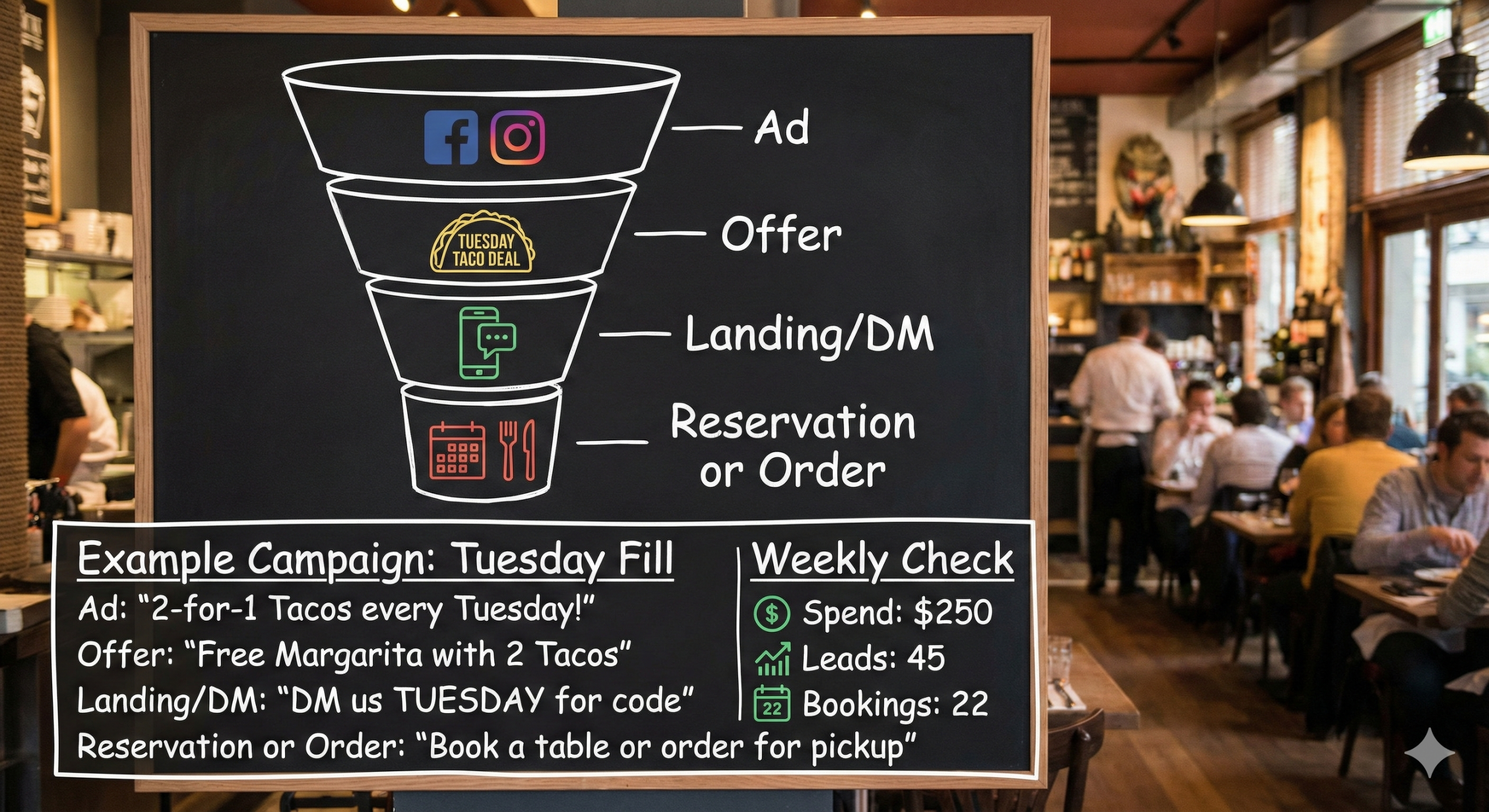
Before you pick ideas, pick one goal (so results show up)
Most restaurant advertising fails because everything is “kinda” promoted at once. Pick one goal for the next 14 days:
Goal A: Fill slow days
Best for Monday to Thursday traffic dips, lunch gaps, and early week delivery.
Track: reservations, calls, direction clicks, online orders, redemptions of a code.
Goal B: Get first time guests
Best when you have a strong signature item and good reviews, but the neighborhood still “does not know you”.
Track: new customer coupon redemptions, first time online orders, new reservation names.
Goal C: Increase repeat visits
Best when you already have steady traffic but want more frequency and higher lifetime value.
Track: repeat coupon usage, loyalty sign ups, return order rate, email or SMS list growth.
Restaurant advertising ideas by category (27 that are easy to execute)
Category 1: Fill slow nights fast (1 to 9)
1) “Weekday Signature” special (limited hours)
Offer example: “Tuesday Burger + Fries + Drink for $15, 4pm to 7pm only.”
Ad angle: “Your new Tuesday tradition.”
Tip: Put the hours in the creative, not only in the caption.
2) Early bird bundle (dine in)
Offer example: “Early Dinner Bundle: 2 entrees + appetizer for $39 before 6pm.”
Why it works: It shifts demand, not margin, when your kitchen is underused.
3) “Kids eat for $X” with a strict condition
Offer example: “Kids meal $2 with purchase of any adult entree, Mon to Wed.”
Make it profitable: Add a minimum entree price, or limit it to one child per adult.
4) Rainy day rescue (weather triggered)
Offer example: “It’s raining: Free soup add on with any delivery order today.”
Ad angle: “Comfort food, delivered.”
Execution: You can swap this in as a story and a same day ad when forecast looks bad.
5) Local worker lunch pass
Offer example: “Hospital and school staff: 10% off lunch with badge.”
Ad angle: “Fast, consistent lunch near you.”
Bonus: Ask them to join your SMS list for weekly lunch deals.
6) “Last table” reminder ads (decision stage)
Offer example: No discount needed. “Only a few tables left for tonight.”
Best for: Thursday to Saturday, when urgency converts.
7) Game day family pack (takeout)
Offer example: “Game Day Pack: wings + pizza + salad feeds 4.”
Ad angle: “Dinner handled in 20 minutes.”
Upsell: Add dessert at checkout.
8) Neighborhood night with a micro partner
Offer example: “Show your receipt from the yoga studio next door, get a free mocktail.”
Ad angle: “Local perks for locals.”
9) “Chef’s choice” fixed price tasting (small plate concept)
Offer example: “Chef’s 3 course for $29, Wednesdays only.”
Why it works: You simplify ordering and reduce decision friction.
Category 2: Get first time guests (10 to 17)
10) The “first visit” offer that is not a deep discount
Offer example: “Free appetizer on your first visit when you reserve online.”
Why: Your food margin survives better than 20% off the whole ticket.
11) 3 signature items video ad (food porn, but structured)
What to show: 2 seconds each: signature dish, sizzling moment, final plated shot.
Copy example: “If you love crispy, melty, and spicy, you need this.”
CTA: “Reserve” or “Order now”, not “Learn more”.
12) “Best reviewed in the area” proof ad
What to show: Screenshot style graphic with star rating and a short quote.
Rule: Use real reviews and keep it short.
Bonus: Ask for more reviews right after the visit.
13) New mover welcome
Offer example: “New to the neighborhood? Free dessert with any entree.”
Where to target: zip codes with active real estate turnover, or radius targeting around new builds.
14) Friends bring friends (two person offer)
Offer example: “Bring a friend: 2 entrees + 1 dessert for $45.”
Why: It increases party size and reduces the “I’ll go alone later” delay.
15) “Taste of” sampler for indecisive customers
Offer example: “Sampler board: 3 mini items for $18.”
Ad angle: “Try us without committing to one dish.”
16) Local influencer but with a strict deliverable
Deliverable example: 1 reel, 3 story frames with a trackable code, 1 pinned comment with CTA.
Avoid: vague “come try it” posts.
Compliance: Make sure sponsored content is disclosed (FTC guidance).
17) Community hook
Offer example: “Every Monday, $1 per bowl donated to local food bank.”
Why: People share cause based posts more, and it creates a weekly ritual.
Category 3: Increase repeat visits (18 to 23)
18) Bounce back card (simple, trackable)
Offer example: “Bring this back within 10 days: free side.”
Make it work: Put a short expiry to create urgency.
19) VIP SMS list with one weekly message
Offer example text: “VIP only: Thursday 5 to 7pm, free appetizer with any 2 entrees. Reply YES to claim.”
Rule: Keep it once per week. Consistency beats volume.
20) Monthly limited item drop
Example: “February: Hot Honey Chicken Sandwich returns for 14 days.”
Ad angle: “Back by request.”
Why: Scarcity creates repeat visits without discounting.
21) Post purchase remarketing for delivery
Example: “Reorder your favorite in 2 taps.”
Creative: show the same dish they ordered, not a random collage.
22) Birthday and anniversary automation
Offer example: “Free dessert on your birthday week.”
Capture method: Add birthday field on your WiFi splash page or simple form.
23) Loyalty punch without an app
Example: “Buy 5 lunches, get the 6th free” tracked via phone number at POS.
Why: Lower friction than an app download.
Category 4: Free or low cost visibility that still converts (24 to 27)
24) Google Business Profile weekly post
Post 1 offer or event per week, plus photos that match your best sellers.
This is a “quiet conversion machine” when people are already searching nearby.
25) Review reply script that increases return visits
When you reply, invite them back with a specific hook: “Next time, try the brisket tacos on Tuesday.”
That is subtle, but it works.
26) Menu spotlight carousel with one decision
Structure: 1 hero item, 3 supporting items, 1 clear CTA.
Avoid: 15 items in one post.
27) Simple referral with a code
Offer: “Give $5, get $5” with a code like FRIEND5.
Tip: Use a different code each month to track.
Proof element: Copy and paste templates you can use today
Template 1: Meta ad copy for filling a slow night
Headline: “Tuesday is handled.”
Primary text: “Dinner plans solved. Get our Burger + Fries + Drink for $15, today only 4pm to 7pm. Reserve now or walk in.”
CTA: Reserve Now
Template 2: Story script for a signature dish
“Stop scrolling. This is the crunch.”
Show the sizzle or pull shot
“Try it tonight. Tap to reserve.”
Template 3: SMS weekly VIP
“VIP deal: Thu 5 to 7pm only. Free appetizer with any 2 entrees. Reply YES and we’ll hold it for you.”
Budget and prioritization (simple and realistic)
If you are a small restaurant, you do not need 12 campaigns. Start with one:
One offer (weekday fill or first visit)
One conversion path (reserve link, order link, or DM)
One creative style (short reel plus one static)
A practical ad spend starting point is often a consistent monthly level that lets the algorithm learn. Many restaurants run a structured Meta ads program starting at $2,000 per month in media spend, then scale when the offer is proven.
Common mistakes that kill restaurant advertising
Running an offer with no deadline
No deadline means “I’ll do it later.” Later becomes never.
Promoting everything at once
One campaign per goal wins. Mixed goals confuse your results and your team.
Great ads, weak conversion path
If your reservation link is slow, your menu is outdated, or your Google profile is messy, you pay more for every customer.
Discounting the whole menu
It trains guests to wait for deals. Use bundles, add ons, or limited windows instead.
A simple 30 day rollout plan (one idea per week)
Week 1: Setup and baseline
Pick one goal (fill slow days or first time guests)
Choose one offer
Fix the top three friction points: hours, menu link, reservation link
Week 2: Launch one campaign and one organic support post
Run the offer
Post the same offer organically
Track redemptions with one code
Week 3: Add remarketing and one proof creative
Add a review based creative
Add a “last table” reminder angle for decision stage
Week 4: Build repeat engine
Add a bounce back offer
Start the weekly VIP SMS list
If you want this managed end to end with a lean scope focused on results, a common structure is Meta ads management plus simple social setup, and optionally Google Business Profile management depending on the plan.
FAQ
What are the best restaurant advertising ideas for a low budget?
Start with one weekday offer, one short video, and one clear CTA. Pair it with Google Business Profile updates and review replies so you convert high intent searches.
Should restaurants advertise on Google or Facebook first?
If your goal is demand generation and you have good creative, Meta can drive fast volume. If your goal is capturing nearby searchers, Google Business Profile and search intent matter. Many restaurants use both, but even one channel can work if the offer and tracking are tight.
How often should I run promotions?
Run one primary promotion for 14 days, then iterate. Too many changes prevents learning and makes results noisy.
What offer works best to fill slow days?
Bundles with a time window usually beat percentage discounts. Examples: early bird bundle, fixed price tasting night, lunch pass for local workers.
Do influencer posts actually work for restaurants?
They can, if you require a trackable code, a clear CTA, and disclosure. Without that, it is usually just views without revenue.
What metrics should I check every week?
Spend, cost per lead or click, and actual outcomes (reservations, orders, code redemptions). If outcomes are not tracked, you are guessing.
Conclusion
You do not need more random posting. You need one focused plan built around a real offer, a clean path to reserve or order, and a simple weekly tracking loop. Pick 2 to 3 of the restaurant advertising ideas above, run them for 14 days, and keep only what proves itself.