



This guide shows you how to choose an agency that actually ties marketing to revenue, with simple questions and a 30-day plan you can use immediately.
You will leave with:
- A step-by-step method to pick the right agency (without guesswork)
- The exact questions to ask (and what good answers sound like)
- A 30-day onboarding checklist to get results faster
If you want fewer meetings, less back-and-forth, and more measurable outcomes, this is for you.
Quick Answer (do this first)
- Pick one business goal (reservations, walk-ins, catering leads, repeat visits) and one primary channel to start.
- Ask for a 30-day pilot plan with deliverables, tracking, and weekly updates.
- Force clarity on offers (what you will promote and why) before talking about creatives.
- Require tracking basics (pixel, events, offline conversions) so spend can be optimized.
- Use a checklist (below) to avoid “random acts of marketing.”
What a restaurant marketing agency actually does (and does not)
A good agency is not a content factory. It is a revenue partner that:
- Identifies your best growth lever (slow days, lunch, delivery, private events, catering)
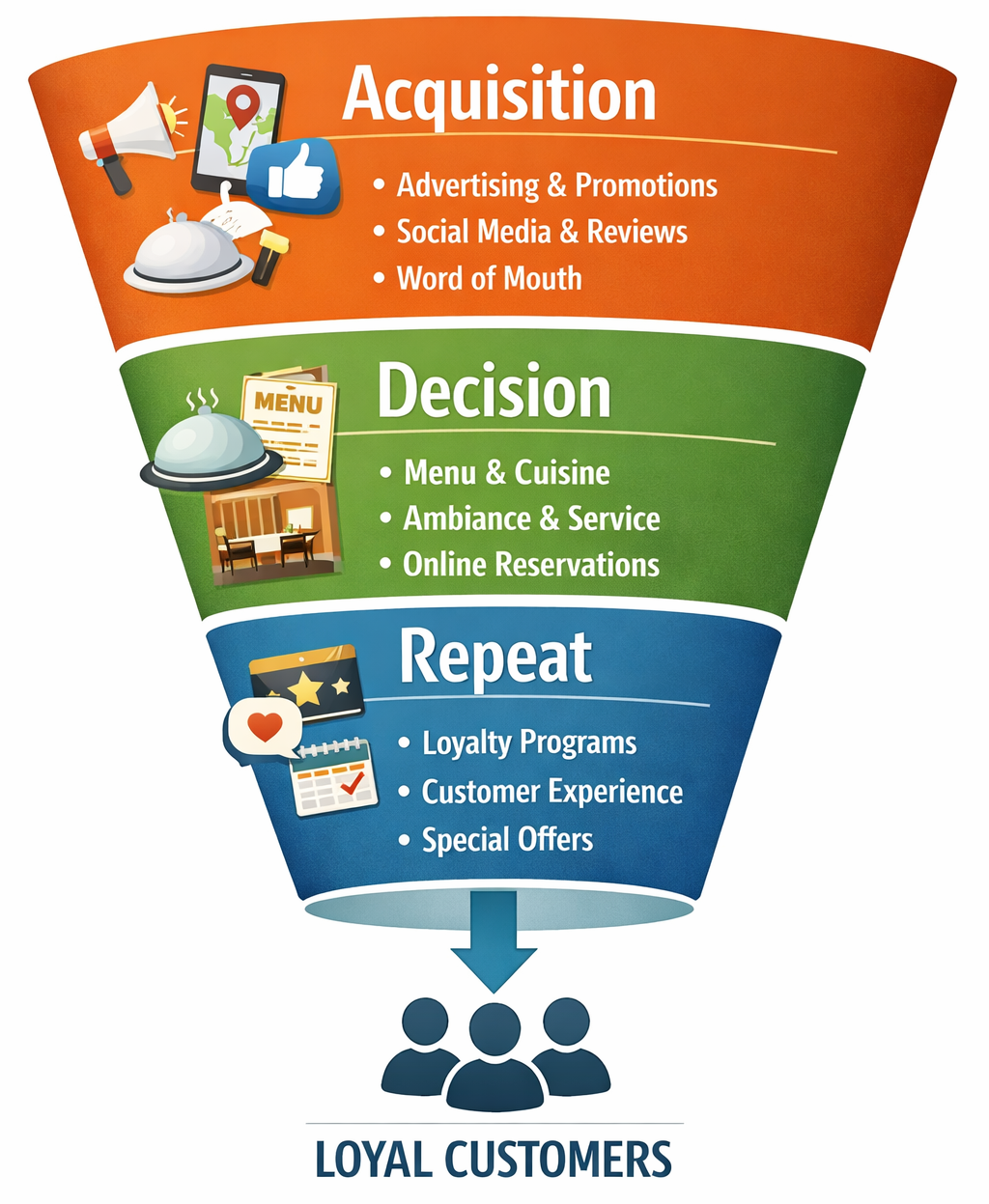
- Builds a simple funnel (new guests + retargeting + repeat)
- Runs paid campaigns with clear goals and measurement
- Improves your digital profile (reviews, photos, info accuracy) to convert demand into visits
What it should not do:
- Post “because it’s Tuesday”
- Chase likes as the main KPI
- Require you to approve every piece of content (that slows execution and kills ROI)
Real-world example
A casual Mexican spot is slow Monday to Wednesday. The agency should not start with “new brand colors.” It should start with: weekday offer, targeting radius, creative angles, and a retargeting loop for people who viewed the menu but did not visit.
Step-by-step: How to choose a restaurant marketing agency
Step-by-step: How to choose a restaurant marketing agency
Pick one:
- “More dinner reservations Sun to Thu”
- “More lunch traffic within 2 miles”
- “More catering leads for offices”
- “More repeat visits from past guests”
If the agency cannot translate that into a plan, pass.
Step 2: Ask what they will stop doing
Great agencies protect your budget by saying “no” to low-impact work.
A strong answer sounds like:
“We will not spread spend across 6 channels. We start with one, prove ROI, then expand.”
Step 3: Check if they understand restaurant math
They should talk about:
- Average ticket
- Margin range
- Capacity and peak hours
- Repeat rate (even if estimated)
- Break-even cost per new guest
Example
If your average dinner ticket is $45 and margin is 18%, your profit per guest is about $8.10. An agency needs that reality to set a cost-per-guest target that makes sense.
Step 4: Validate proof the right way
If you do not have case studies, you can still validate competence by asking for:
- A sample campaign structure (acquisition + retargeting)
- A sample weekly reporting format
- A sample offer calendar for a restaurant like yours
Step 5: Start with a pilot, not a long contract
A 30-day pilot forces focus and reveals execution speed.
The 12 questions to ask before you sign (with good vs bad answers)
“What would you do in the first 7 days?”
Good: tracking + offer + campaign structure + profile cleanup.
Bad: “We will brainstorm content pillars.”“What is your core channel?”
Good: one primary channel to prove ROI first.
Bad: “We do everything.”“How do you track performance?”
Good: pixel/events + offline attribution options + clear KPIs.
Bad: “We track engagement.”“What do you need from me every week?”
Good: sales notes, promos, capacity constraints, one point of contact.
Bad: “Nothing,” or “Approve 20 posts.”“How do you handle creative production?”
Good: simple system, templates, fast iteration, creative tied to offers.
Bad: “We will do a full brand shoot every month” (unless you are high-end and can justify it).“How do you deal with reviews?”
Good: consistent replies, escalation process, and guidance on requesting reviews.
Bad: “We do not touch that.”“What does weekly communication look like?”
Good: short weekly update + action list.
Bad: “Monthly meeting only.”“What is the minimum ad spend you recommend?”
Good: a clear minimum based on your market size and goals.
Bad: vague answers.“What offers work for restaurants like mine?”
Good: specific examples (see next section).
Bad: “Discounts.”“How do you avoid wasting budget?”
Good: negative targeting, frequency control, creative rotation, retargeting rules.
Bad: “We let the algorithm do it.”“What do you optimize for?”
Good: reservations, calls, directions, online orders, or lead quality.
Bad: “Reach.”“What happens if results are flat after 30 days?”
Good: a diagnosis path (offer, tracking, audience, creative, landing).
Bad: “It takes time” with no plan.
Offers that actually work (examples you can copy)
Most restaurant marketing fails because the offer is generic. Here are practical, proven-style angles you can test.
1) Slow-day traffic
- “Weekday Dinner for Two” bundle
- “Kids eat for $X” (specific days)
- “Late-night special 9 pm to close”
Example: Pizzeria
“2 slices + drink lunch combo” targeted to offices within 1.5 miles, Mon to Fri 10:30 am to 1:30 pm.
2) Slow-day traffic
- First-visit incentive that protects margin: “Free appetizer with entree” beats “20% off” for many concepts.
- Signature item hook: “Try our top-rated ramen bowl.
3) Retargeting for decision
Run ads only to people who:
- viewed your menu
- engaged with IG
- watched 50% of a video
Then push a simple call to action: “Book tonight” or “Get directions.”
4) Catering and private events
- “Office lunch packages from $X per person”
- “Private dining for groups of 12 to 40”
Tracking basics you should require (so ads can improve)
If you run paid social, insist on clean measurement so optimization is real, not vibes:
- Meta Pixel installed and firing key events
- Events mapped to outcomes (reservation button click, order confirmation, lead form submit)
- If possible, Conversions API to strengthen event matching and performance
If your agency avoids tracking setup, that is a major red flag.
Common mistakes restaurant owners make when hiring an agency
- Hiring for aesthetics instead of outcomes
Pretty posts do not guarantee covers. - No offer, no strategy
If there is no reason to visit this week, ads will be expensive. - Changing priorities every 10 days
Restaurants are dynamic, but marketing needs at least one focused cycle. - Not managing reviews
Demand leaks if your profile looks neglected. Google provides clear steps to manage and reply to reviews.
30-day onboarding checklist (owner + agency)
- Hiring for aesthetics instead of outcomes
Pretty posts do not guarantee covers. - No offer, no strategy
If there is no reason to visit this week, ads will be expensive. - Changing priorities every 10 days
Restaurants are dynamic, but marketing needs at least one focused cycle. - Not managing reviews
Demand leaks if your profile looks neglected. Google provides clear steps to manage and reply to reviews.
Week 1: Foundation
- Access to ad accounts, pages, and website
- Tracking installed (pixel, events)
- One primary offer chosen
- Radius and audience defined
Week 2: Launch
- Acquisition campaign live
- Retargeting campaign live
- Creative rotation plan (2 to 4 angles)
Week 3: Optimize
- Cut losers, scale winners
- Update offer messaging if CTR is fine but conversions are weak
- Add new creatives based on comments and FAQs from guests
Week 4: Lock in what works
- “Winning offer + audience + creative” documented
- Next month plan: one new test, one scale move
Pricing reality check (so you do not get surprised)
Most restaurants should separate:
- Agency management fee (strategy + execution)
- Media spend (the ad budget)
If you want an example of a simple, productized structure (built for restaurants), you can reference our current packages here:
(Example structure includes Meta ads management with a defined minimum monthly media investment, plus optional social setup and operational reporting.)
FAQ
What is the best restaurant marketing agency?
The best one is the one that can show a clear 30-day plan tied to your goal, has fast execution, and measures performance beyond likes.
How much does a restaurant marketing agency cost?
It varies by scope and market. Ask for a monthly management fee plus a recommended minimum ad budget, tpected return per new guest.
Should a restaurant marketing agency run Google ads too?
Not always. Many restaurants win with one primary channel first, then expand. If your priority is immediate demand capture, local search and your profile matter a lot, even without Google ads.
How long until I see results?
Often you can see early signals in 7 to 14 days (cost per click, bookings, calls). True efficiency improvements typically come after testing offers and creatives for a few cycles.
What should I provide to the agency each week?
Promo changes, sold-out items, capacity constraints, and any high-margin items you want to push.
What are red flags when hiring a restaurant marketing company?
No tracking plan, no offer strategy, unclear reporting, and long contracts before any pilot.
Conclusion
To choose the right restaurant marketing agency, do three things:
- Define one goal (not five)
- Demand a 30-day plan with tracking and offers
- Use the checklist and questions above to filter fast
If you want a lean, restaurant-only approach focused on measurable outcomes (not endless approvals), check our service and pricing pages here and request a 30-day growth plan.